


— ARTICLE AT A GLANCE
Who this is for: Property owners, facility managers, building operators, risk managers, insurers, and professionals responsible for responding to water damage.
What you’ll learn: Why rapid structural drying matters after a water loss; how extraction, airflow, and dehumidification support effective drying; and how moisture monitoring can help reduce mold and further property damage.
Read time: 8-10 minutes.
Every day, there are water loss occurrences in buildings across the US, requiring prompt and strategic action to avoid prolonged issues. These water losses can be the result of multiple issues, including the following situations:
- Pipe breaks/leaks;
- Bathtub and sink overflows;
- Appliance Failures (including dishwasher, washing machine, & water heaters);
- Sewage backups; and
- Severe Weather & Stormwater Flooding.
Water damage is a leading cause for insurance claims. According to an analysis of government and industrial data by the Consumer Affairs Journal of Consumer Research, the average cost of household water damage claims was approximately $12,500 between 2017 and 2021, though the geographic location and volume of water involved affects the overall mitigation and repair cost. Large volume water losses may result in exponential increases in the overall resolution and restoration cost. Additionally, the prolonged presence of moisture within structures after a water loss increases the risk for mold growth, requires further remedial actions, and escalates total cost.
This article provides an overview of the importance of and consideration for drying these structures.
Why is drying important?
The overall goal of restoration following a water loss event includes proper drying to remove water and excess moisture/humidity from within a structure following an unwanted accidental release or infiltration of water, in an effort to return the structure, components, and contents to their normal moisture content/humidity and pre-loss condition.
Regardless of the volume of the loss, water quickly flows laterally and wicks into standard building materials (drywall, framing, cabinetry, carpet and associated padding, and subfloor sheeting). Moisture is absorbed into surrounding porous materials and furnishings in the area of the water loss and may potentially migrate through cracks/crevices between finished materials – areas that are not readily accessible. The larger the volume of water associated with the loss, the greater the extent of the building materials impacted.
Aside from urgency, there are many considerations for the property owner when structural drying is necessary, such as availability of remediation and restoration resources, contractor experience, and personal, business and/or tenant needs.
Mold naturally exists everywhere in the outdoor environment and is a natural decomposer of organic matter. Under proper conditions, as mold grows and propagates, it releases mold spores into the air, which are carried by air flow/air current onto other surfaces. The mold spores require three (3) primary conditions to grow: an organic food source or substrate, oxygen, and moisture. Although it’s not an absolute condition, different genus/species of mold also favor certain temperature conditions to some extent.
How Quickly Should Structural Drying Begin?
Under the above-mentioned conditions, mold can grow within 24- to 48- hours . As available moisture increases as part of a water loss event, the overall ecology shifts to favor the growth and amplification of molds. Mold growth on building materials and contents is directly correlated to this new source of moisture in the affected building, inclusive of water infiltration, surface water activity, moisture content, and relative humidity. Therefore, it is important to remove and dry out the affected building materials and other contents within this “golden” period of 24-48 hours in hopes of preventing any associated mold growth.
Another consideration is the category of the water involved with the loss. There are three (3) categories:
- Category 1 (Clean Water) – Water emanating from clean, sanitary sources that poses no substantial risk to humans, including broken water supply lines, bathtub/sink overflows, melting snow, and/or falling rainwater. No treatment is required.
- Category 2 (Gray Water) – Water containing significant contamination and having the potential to cause illness if consumed or contacted, including discharges from dishwashers or washing machines, overflows from toilet bowls (without fecal matter), and/or sump pump failures. Requires disinfection.
- Category 3 (Black Water) – Grossly contaminated, unsafe, and containing pathogenic, toxigenic, or other harmful agents, including sewage, toilet backflows from beyond the toilet trap, rising flood water from rivers/streams, seawater, and/or flowing ground surface water. Requires hazardous material cleanup procedures, including removal of all contaminated porous materials.
How Do You Begin Structural Drying After Water Damage?
There are four (4) general underlying drying principles, which include: extraction, evaporation, promoting dehumidification, and controlling temperature.
Primarily, standing water should be initially extracted with mops, wet vacs, and/or trash pumps from affected areas of the structure. Simultaneously to the extraction, an evaluation of what materials exist and are saturated in the affected area should be conducted to determine whether these materials and contents need to be removed and discarded. However, these decisions should include knowledge of the category of the water loss (removal and disposal for Category 3 losses) as well as the porosity and susceptibility of the material.
Porous materials (including drywall, ceiling tiles, insulation, particle board/fiber board, and paper products) should be removed and discarded. If these contents cannot be readily dried and cleaned through surface wiping and have no sentimental significance or monetary value, then disposal is recommended. If extenuating sentimental or monetary conditions exist, consider moving the objects to a separate location or a tented containment with an operating dehumidifier for controlled drying. Other drying options exist for some materials, including specialty drying services like freeze drying. Freeze drying is a process frequently used for books and other historically significant paperwork.
Separately, existing carpeting, including associated carpet padding and underlying subfloor, should be evaluated to determine if the products are salvageable or can be effectively dried. The total volume of water that saturated the flooring should be considered as part of this evaluation. Because existing carpet, padding, and subflooring can be difficult to dry following a water loss event (even with the use of water extraction equipment and dehumidifiers), , it may be recommended to lift and separate the carpet, pad, and subfloor with axil blowers that move air between the layers while also operating dehumidifiers to promote thorough drying. Alternatively, specific carpet drying systems that some drying companies use to focus the extraction and evaporation of moisture with applied air flow to dry the carpeting in-place can be effective.
Thereafter, evaluation of any drywall damage is performed. Consideration for whether to cut or drill drying holes in saturated lower gypsum drywall after removal of the associated baseboard verses the physical removal of the saturated lower gypsum drywall to expose and dry the wall cavities is determined. Adequate air flow should be directed or ducted into the wall cavity to promote evaporation of moisture; however, exhaust holes should also be installed in another portion of the wall cavity for evaporated moisture to exit at another point in the assembly and subsequently get picked up by dehumidifiers operating in the drying space.
Additionally, the presence of insulation within the wall cavity should be factored into the decision, as the presence of wet insulation in the lower wall cavities reduces air flow and prolongs the time necessary to dry the cavities. Axil blowers/air movers or specifically manufactured wall cavity drying systems, which limit damage, can also be used to promote air exchange/evaporation and drying within the wall system.
While drywall is less damaged and requires fewer repairs if limited drying holes are cut/drilled behind removed areas of baseboard, removal of the lower 6- to 12-inches of gypsum drywall, especially when it’s wet, offers a more efficient approach for drying purposes since it opens more area within the wall and exposes any insulation present in the cavity.
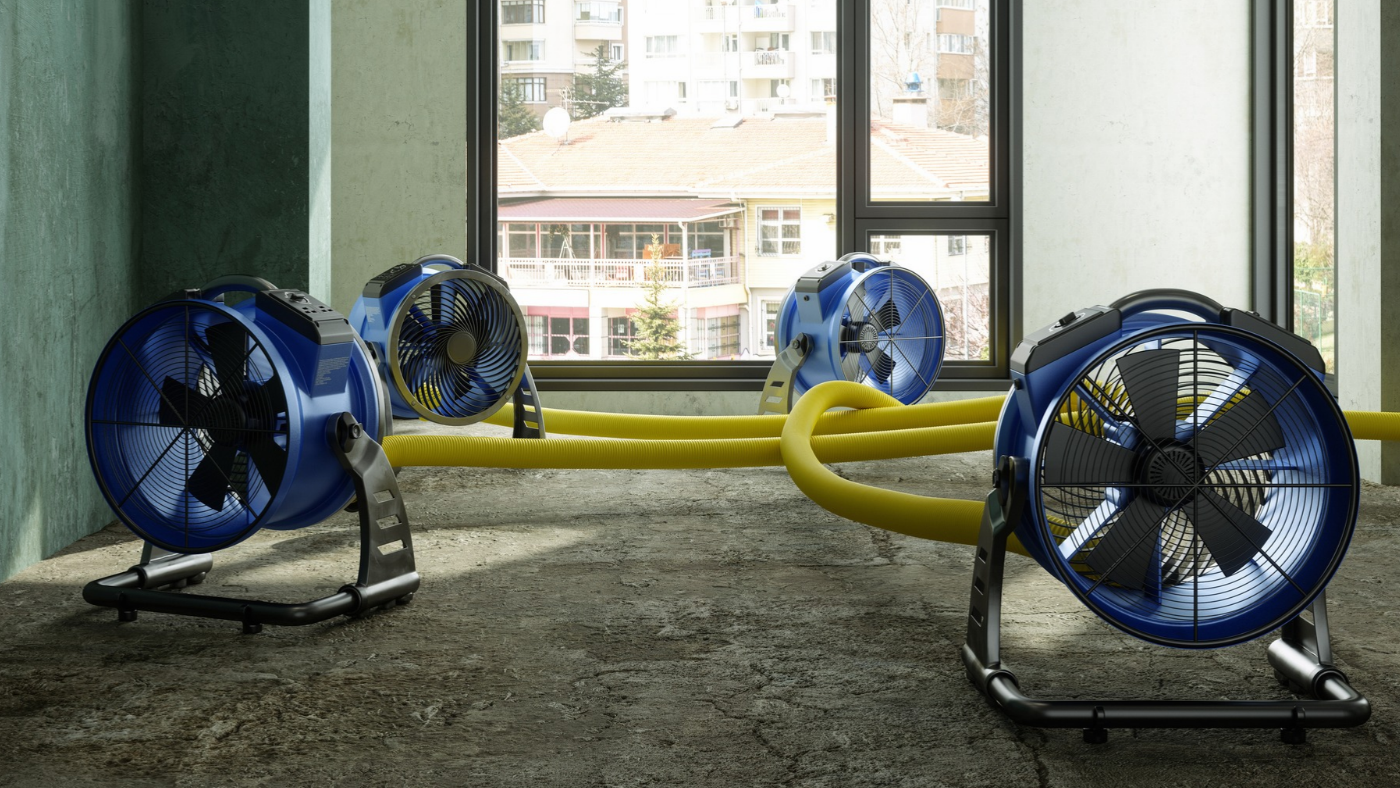
Dehumidification can be an effective mechanism for removing moisture directly from the air or indirectly from room content and building materials. The two most common dehumidifiers are refrigerant dehumidifiers and desiccant dehumidifiers. Refrigerant dehumidifiers work on the principle of condensation and are most efficient above 70 degrees Fahrenheit (°F); typically, the lowest moisture levels they can achieve are a dew point of 46°F and humidity of 48%. Desiccant dehumidifiers work on the principle of absorption, with a key component being a desiccant (frequently a silica gel) impregnated rotor or wheel. They can typically dehumidify air to a dew point of 20°F but can manage more air flow; therefore, they can be more efficient in overall moisture removal.
How Do You Know When a Structure Is Properly Dried?
Frequent moisture monitoring of the affected building materials is warranted on at least a daily basis, as well as to ensure that air movers/blowers and dehumidifiers remain operational. As building materials dry and other areas retain residual moisture, the air movers/blowers need to be frequently refocused to dry the areas containing residual moisture.
Moisture meters and hygrometers should be used to assess initial and residual moisture content, temperature, and relative humidity (defined as the amount of moisture in air relative to the total amount of moisture the air can hold at a given temperature). Measurements should be collected each day and recorded to track the progress of the drying efforts and for future reference, as necessary. These are considered several of the relevant psychrometric properties relative to moist air vapor and moisture removal.
Psychrometrics is the physical and thermodynamic study of air-water vapor mixtures and the processes that result in changes to temperature or humidity. These principles are important during structural drying as their use is essential in evaluating and controlling indoor air quality and humidity within the affected spaces. Other key psychrometric properties include the following:
- Dew Point Temperature – The temperature at which moisture condenses (when the air column is saturated).
- Enthalpy – The total heat energy of the air.
- Dry-Bulb Temperature – The standard air temperature. It is the temperature indicated by a thermometer exposed to the air when sheltered from direct solar radiation.
- Wet-Bulb Temperature – The temperature measured by a moistened bulb, indicative for evaporative cooling.
- Latent Heat – The heat required to evaporate moisture contained in a specific volume of air with evaporation occurring at the wet-bulb temperate and expressed in Btu per pound.
- Sensible Heat – The amount of dry heat expressed in Btu per pound of air, reflected by dry-bulb temperature.
- Total Heat – The total heat content of air is referred to has enthalpy and is expressed in Btu per pound of air.
Dehumidification is the process of absorbing heat from air which forces water vapor to condense as it cools, therein reducing moisture content in the air column within the space. Knowing the Wet-Bulb Temperature and Dry-Bulb Temperature allows the user to calculate relative humidity and the quantity of moisture removed (calculated as grains of moisture per pound of dry air) via a psychrometric data chart, which is a graphical representation of the thermodynamic parameters for moist air at constant pressure. In structure drying applications, one should seek to achieve an optimal balance between low relative humidity, which increases the drying rate, and energy usage, which decreases relative to increased humidity. It is important to avoid the formation of condensation, which would be counter to actual drying.
To determine whether drying efforts have been successful and can be discontinued, the affected building materials should reflect standard moisture content and air vapor in the space should show significantly decreased grains of moisture per pound of dry air. There are multiple computer software packages commercially available for tracking these psychrometric parameters, which advise when the building space has been adequately dried. Failure to control moisture and adequately dry affected building areas can result in mold growth.
Recommendations
Early and rapid intervention in response to water losses can minimize – if not prevent – prolonged moisture content in building materials and contents that would be conducive to mold growth.
Building owners, managers, and maintenance staff should identify and establish relationships with emergency response contractors that offer water extraction and structural drying services in a preemptive manner so that they can quickly be engaged to promptly respond to new water loss incidents. Additionally, it is important to know where water supply and fire protection shut-off valves are located and establish specific standard operating procedures for actions that they can promptly take to conduct initial water extraction actions.
Vertex’s team of multidisciplinary experts supports clients with Environmental Claims Consulting and Environmental Loss Control Consulting, among other needs. To discuss how we can support your project, submit an inquiry through our form below.